
Retinol has long been considered one of the most effective ingredients in anti-aging skincare. From softening fine lines to improving uneven skin tone, this vitamin A derivative has earned its reputation through decades of scientific research.
But what happens when your skin cannot tolerate it?
For many women in their 30s, 40s, and 50s, retinol can come with unwanted side effects, including dryness, redness, peeling, and irritation. While the promise of smoother, younger-looking skin is appealing, dealing with uncomfortable reactions can make even the most carefully planned skincare routine difficult to maintain.
Enter bakuchiol, a plant-derived ingredient gaining attention as a gentler alternative to traditional retinol.
The growing conversation around bakuchiol vs retinol raises an important question: can a natural ingredient really deliver comparable anti-aging results without the irritation?
Scientific studies suggest that bakuchiol has genuine potential. However, understanding how these ingredients work, what clinical trials reveal, and which one suits your skin is essential before making the switch.
What Is Bakuchiol, and Why Is Everyone Comparing It to Retinol?
Bakuchiol is a plant-derived compound commonly extracted from the seeds of Psoralea corylifolia, also known as the babchi plant. Traditionally associated with botanical preparations, it has attracted modern skincare researchers because of its antioxidant properties and potential effects on visible skin aging.
Unlike retinol, bakuchiol is not a vitamin A derivative. It has a different chemical structure and does not become retinoic acid inside the skin. Nevertheless, laboratory research suggests that bakuchiol can influence some of the same biological processes associated with healthier-looking skin.
Its potential benefits include improving the appearance of fine lines, supporting skin firmness, reducing uneven pigmentation, and helping protect against oxidative stress. These properties have made bakuchiol particularly appealing to people searching for a natural retinol alternative that fits into a gentler skincare routine.
However, natural origin does not automatically mean better performance or zero irritation. What matters most is the ingredient's clinical evidence, concentration, formulation, and compatibility with your skin.
Bakuchiol vs Retinol: How Do They Actually Work?
Although bakuchiol and retinol may produce similar cosmetic improvements, their mechanisms are different.
Retinol: The Vitamin A Approach
Retinol belongs to the retinoid family, a group of compounds related to vitamin A.
After application, retinol undergoes conversion into retinaldehyde and then retinoic acid, the biologically active form that interacts with retinoic acid receptors in skin cells.
These interactions influence gene expression involved in skin renewal, pigmentation, and collagen regulation. With consistent use, retinol can help improve uneven texture, soften fine lines, and reduce visible signs of photoaging.
Retinoids also have established effects on collagen production and collagen-degrading enzymes, making them important ingredients in evidence-based anti-aging skincare. However, retinoid activity can disrupt skin comfort during the adjustment period, particularly when a strong formula is introduced too quickly.
Bakuchiol: A Different Pathway to Similar Goals
Bakuchiol does not need to convert into retinoic acid to exert its effects.
Instead, laboratory studies suggest that it influences several gene-expression pathways associated with skin structure, antioxidant defense, and collagen-related processes. A 2014 study published in the International Journal of Cosmetic Science identified similarities between the gene-expression profiles associated with bakuchiol and retinol.
Researchers also observed changes involving collagen types I, III, and IV in experimental models, alongside improvements in visible skin aging in a small clinical assessment. This suggests that bakuchiol may support some of the same anti-aging outcomes through different biological mechanisms.
The important distinction is that similar laboratory activity does not automatically establish equal clinical strength. Retinol has a much larger body of research, while bakuchiol remains an emerging ingredient with promising but more limited human evidence.
What Do Clinical Studies Actually Say?
The most meaningful evidence in the bakuchiol vs retinol discussion comes from a randomized, double-blind clinical trial published in the British Journal of Dermatology in 2019.
The study involved 44 participants and compared two skincare regimens over 12 weeks.
One group applied a 0.5% bakuchiol cream twice daily, while the other used a 0.5% retinol cream once daily.
Researchers evaluated changes in wrinkles, pigmentation, and skin tolerance using standardized photography and clinical assessments.
The Head-to-Head Results
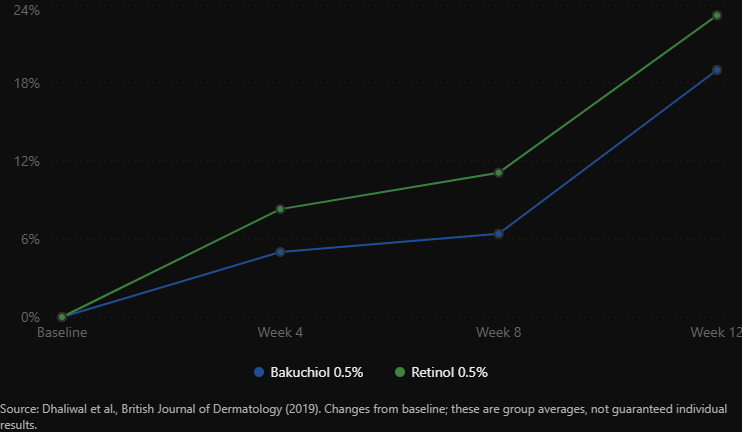
At the end of the trial, both ingredients significantly reduced fine-wrinkle surface area and improved hyperpigmentation.
Retinol produced numerically greater wrinkle improvement, but the difference between treatments was not statistically significant. More importantly for sensitive skin, retinol users experienced significantly more scaling and stinging. These results suggest that bakuchiol can produce meaningful improvements in photoaged skin while offering better tolerability in the tested formulations.
However, this does not prove that bakuchiol is universally as effective as retinol. The study was relatively small, lasted only 12 weeks, and used different application frequencies. It also did not directly measure collagen production in participants' skin.
The research supports bakuchiol as a credible alternative, but larger and longer studies are needed to establish how consistently its benefits compare with retinol.
Bakuchiol vs Retinol: Side-by-Side Comparison
| FEATURE | RETINOL | BAKUCHIOL |
|---|---|---|
| Origin | Vitamin A derivative | Plant-derived compound |
| Mechanism | Converts to retinoic acid | Influences overlapping and distinct pathways |
| Fine Lines | Strong evidence | Promising clinical evidence |
| Skin Firmness | Established retinoid benefits | Preliminary evidence |
| Hyperpigmentation | Effective | Promising evidence |
| Irritation | More common | Generally better tolerated |
| Daytime use | Often preferred at night | Can generally be used morning or night |
| Research depth | Extensive | More limited |
| Best suited for | Retinoid-tolerant users | Sensitive or retinol-intolerant user |
Neither ingredient is automatically superior for everyone.
The right choice depends on whether your main priority is maximizing evidence-backed treatment strength, minimizing irritation, or finding a sustainable balance between the two.
How Long Does Bakuchiol Take to Work Compared With Retinol?
One of the biggest concerns when switching skincare ingredients is whether results will take longer to appear. Retinol is often associated with faster visible changes, but its effectiveness depends heavily on concentration, frequency, formulation, and individual skin response. Bakuchiol may offer a more comfortable introduction to anti-aging skincare, although significant improvements still require consistency.
| RETINOL | BAKUCHIOL |
|---|---|
| 4-6 Weeks | 8-12 Weeks |
| Possible early texture changes | Reasonable window to assess visible improvement |
These are approximate expectations, not scientifically established minimum response times. In the direct comparison trial, both groups showed their clearest statistically significant wrinkle improvements at 12 weeks.
Weeks 1–4: Adjustment and Early Changes
During the first month, retinol users may experience dryness, peeling, or increased sensitivity while their skin adjusts. Some individuals notice smoother texture during this period, but substantial wrinkle reduction generally requires longer treatment. Bakuchiol users may experience fewer adjustment-related symptoms, making it easier to maintain regular application.
Weeks 5–8: Building Consistency
By the second month, improvements in texture and overall appearance may become more noticeable. In the head-to-head study, both ingredients showed numerical reductions in fine-wrinkle surface area at eight weeks. However, these early changes should not be interpreted as guaranteed results for every user.
Weeks 9–12: Evaluating Anti-Aging Results
At 12 weeks, the clinical study demonstrated meaningful improvements in wrinkles and pigmentation for both ingredients. This makes three months a practical initial evaluation period for a new routine. Take photographs under consistent lighting, monitor skin comfort, and remember that long-term maintenance matters more than immediate transformation.
Five Bakuchiol Benefits Worth Knowing
Bakuchiol's growing popularity is not based entirely on marketing. Several properties make it an interesting ingredient for people who want anti-aging benefits without relying exclusively on retinoids.
1. Helps Reduce the Appearance of Fine Lines
Clinical research indicates that bakuchiol can improve visible wrinkles with consistent application. Its effects on collagen-related pathways may contribute to smoother-looking skin, although human evidence remains less extensive than that for retinoids.
2. Supports Firmer-Looking Skin
Early research suggests that bakuchiol may influence processes associated with skin elasticity and firmness. This makes it appealing to women experiencing the first signs of declining skin firmness, particularly around the cheeks, forehead, and jawline.
3. Improves Uneven Skin Tone
Sun exposure and aging can contribute to dark spots and uneven pigmentation. The 2019 comparison trial found improvements in hyperpigmentation with both bakuchiol and retinol. For people who find conventional retinoids uncomfortable, bakuchiol may provide another option for addressing visible discoloration.
4. Offers Antioxidant Activity
Environmental exposure and normal cellular processes generate oxidative stress, which contributes to visible skin aging. Laboratory research suggests that bakuchiol has antioxidant properties that may help support the skin's defenses. However, bakuchiol should complement rather than replace daily sunscreen.
5. May Be More Comfortable for Sensitive Skin
Perhaps the most attractive of all bakuchiol benefits is its generally favorable tolerability. The head-to-head trial reported more stinging and scaling among retinol users. This matters because a skincare ingredient can only deliver consistent benefits when someone can comfortably continue using it. Bakuchiol is not irritation-proof, but its tolerability profile makes it worth considering for those who have struggled with retinol.
Who Should Choose Bakuchiol Instead of Retinol?
Bakuchiol may be especially appealing to women whose skin needs have changed over time.
Women With Sensitive or Reactive Skin
If retinol consistently causes burning, peeling, or uncomfortable dryness, bakuchiol may offer a more manageable alternative. Its generally favorable tolerability allows users to focus on long-term consistency rather than repeatedly stopping treatment because of irritation.
Women in Their 30s Starting Anti-Aging Skincare
The early 30s are often when fine lines, uneven texture, and the effects of sun exposure become more noticeable. Bakuchiol can be a reasonable introductory ingredient for women who prefer a gentle approach before considering stronger retinoids.
Women in Their 40s and 50s Seeking Comfortable Maintenance
As skin matures, dryness and changes in barrier function can make previously tolerated products feel uncomfortable. Bakuchiol may help maintain a smoother-looking complexion without the same level of irritation experienced with some retinol formulations. However, women seeking more intensive treatment of pronounced photoaging may benefit from discussing established retinoid options with a dermatologist.
Women With Rosacea-Prone Skin
People with rosacea often react to skincare ingredients that increase redness or compromise skin comfort. Bakuchiol may be worth discussing with a dermatologist, but it has not been adequately established as a rosacea treatment or proven safe for every rosacea-prone complexion. Introduce new products cautiously, particularly during active flare-ups.
Pregnant or Breastfeeding Women
Retinoids are generally avoided during pregnancy, and medical guidance also recommends avoiding retinol during breastfeeding. Although bakuchiol is often marketed as a pregnancy-friendly alternative, reliable human pregnancy and lactation safety data remain insufficient. Therefore, it should not automatically be considered safe simply because it is plant-derived. Women who are pregnant, breastfeeding, or planning pregnancy should consult their healthcare professional before using bakuchiol or other concentrated anti-aging treatments
Why Combine Bakuchiol With Peptides?
Bakuchiol and peptides are an interesting combination for modern anti-aging skincare. Bakuchiol has demonstrated potential for improving visible wrinkles and pigmentation, while selected cosmetic peptides are studied for their roles in supporting skin hydration, appearance, and firmness. Combining these ingredients may offer a broader approach to maintaining healthy-looking skin.
For Elite Skin Perfection, the proposed Botanifique Bakuchiol 2% Serum provides an opportunity to highlight a formula designed around both botanical skincare and peptide technology. However, peptides should not be described as correcting an inability of retinol to stimulate collagen. Retinoids already have well-established collagen-related effects.
Instead, the more scientifically accurate positioning is that bakuchiol and peptides may offer complementary anti-aging benefits in a potentially gentler formulation. Whether the combination outperforms bakuchiol alone would require testing of the finished product.
Can You Use Bakuchiol and Retinol Together?
For women who already tolerate retinol, combining the two ingredients may be another option. One possible routine involves using bakuchiol in the morning and retinol at night. This allows bakuchiol to fit into daytime skincare while reserving retinol for evening application, when it is commonly recommended.
| Morning Routine | Evening Routine |
|---|---|
| Gentle cleanser | Gentle cleanser |
| Bakuchiol serum | Retinol (start gradually) |
| Moisturizer | Barrier- supporting moisturizer |
| Broad-spectrum SPF 30+ |
Is Bakuchiol as Good as Retinol?
The answer depends on what you expect from your skincare.
If your priority is a well-established anti-aging ingredient supported by decades of research, retinol remains the stronger evidence-based choice. If your priority is reducing visible signs of aging while minimizing the risk of uncomfortable irritation, bakuchiol is a credible alternative.
The 2019 head-to-head study demonstrated comparable improvements in the specific wrinkle and pigmentation outcomes measured over 12 weeks, with better tolerability for bakuchiol.
However, the limited number of clinical studies means it would be premature to declare the two ingredients completely interchangeable. Bakuchiol may also be less potent than stronger prescription retinoids, which have different concentrations, mechanisms, and clinical uses.
Ultimately, the most effective skincare routine is one that addresses your concerns without repeatedly compromising your skin's comfort.
Final Verdict: Is the Natural Retinol Alternative Worth It?
When comparing bakuchiol vs retinol, the evidence supports a balanced conclusion. Retinol remains an important anti-aging ingredient with extensive research behind its ability to improve wrinkles, pigmentation, and skin texture. Bakuchiol, meanwhile, offers promising anti-aging benefits and may be easier to tolerate for people who struggle with conventional retinol.
It is not a complete replacement for retinol in every situation, and its long-term clinical evidence is still developing. But for women who value gentle skincare, botanical ingredients, and consistent routines, bakuchiol deserves serious consideration. The goal is not necessarily to choose the strongest ingredient available. It is to find a formula that supports your skin's changing needs and remains comfortable enough to use regularly.
Gentle Anti-Aging Without Irritation
Your anti-aging routine should help you feel confident and comfortable in your skin. Discover skincare options from Elite Skin Perfection and explore a more thoughtful approach to addressing fine lines, uneven texture, and visible signs of aging. Whether you are exploring bakuchiol, peptides, or other gentle skincare ingredients, choosing products suited to your skin can make long-term care more manageable.
