
If you have ever stood in front of your bathroom mirror holding a bottle of hyaluronic acid serum in one hand and a tub of face cream in the other, asking yourself "Do I really need both of these?"—you are not alone.
Navigating modern skincare can feel like decoding a chemistry degree. Between social media trends, 10-step skincare routines, and complex ingredient lists, it is easy to wonder whether using an HA serum alongside a daily moisturizer is a genuine necessity or just marketing hype.
The short answer? Yes, for optimal skin hydration, most people need both. However, they do not do the same job.
Understanding the debate between hyaluronic acid serum vs moisturizer requires looking under the surface of your skin. While both products aim to keep your skin plump, smooth, and supple, they work through entirely different biological mechanisms.
Here is a complete breakdown of how hyaluronic acid works, the crucial differences between serums and creams, how humectants, emollients, and occlusives interact, and how to layer them into a high-performance hydration routine.
What Is Hyaluronic Acid, and Why Is It So Popular?
Before comparing hyaluronic acid serum vs moisturizer, it helps to understand what hyaluronic acid (HA) actually is.
Contrary to what the word "acid" might suggest, hyaluronic acid is not an exfoliating acid like glycolic or salicylic acid. It will not strip or peel your skin. Instead, hyaluronic acid is a naturally occurring glycosaminoglycan—a sugar molecule—found throughout your body's connective tissues, joint fluid, and skin matrix.
Key Biological Functions of Hyaluronic Acid:
Water Retention: A single gram of hyaluronic acid can hold up to 6 liters of water (or up to 1,000 times its weight in moisture).
Skin Elasticity & Volume: In youthful skin, HA fills the space between collagen and elastin fibers, keeping the skin firm and bouncy.
Barrier Support: It helps maintain optimal water balance within the epidermis, aiding skin repair and smoothness.
The Aging Factor
As we age—starting as early as our mid-20s—our body’s natural production of hyaluronic acid slows down. Environmental stressors like UV exposure, pollution, and dry climate conditions accelerate this loss. By age 40, your skin holds roughly half the natural HA it had in your youth. The result? Dehydration lines, dullness, loss of bounce, and increased sensitivity.
This decline is why topical hydration products have become non-negotiable staples in modern skin health.
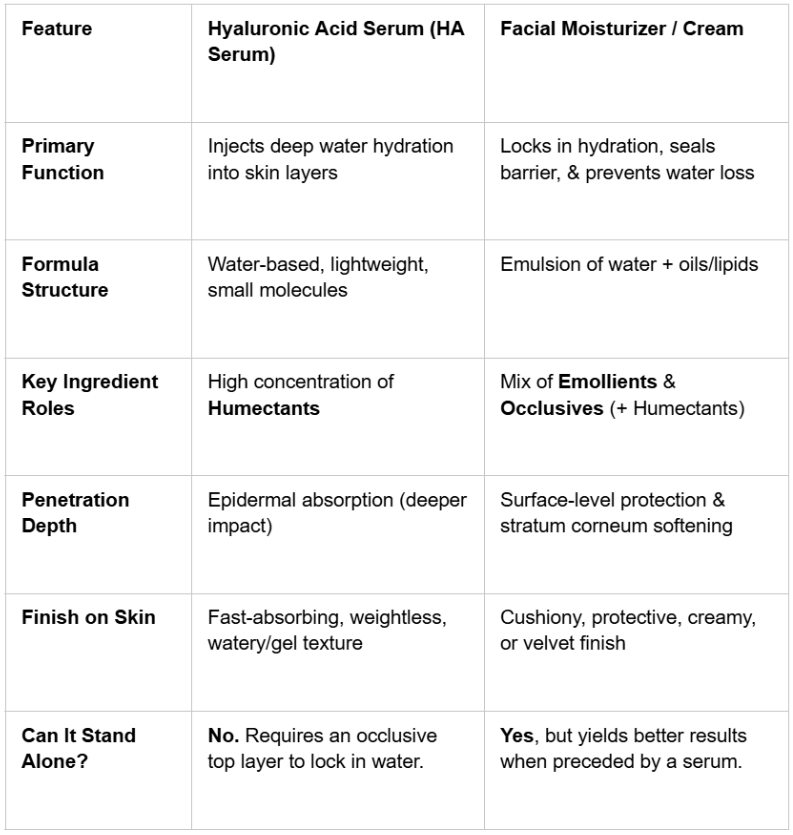
Hyaluronic Acid Serum vs Moisturizer: The Core Differences
To understand why using a moisturizer after hyaluronic acid is so essential, you must first understand the fundamental structural differences between a serum and a moisturizer.
The Science of Hydration: Humectants, Emollients, and Occlusives
To master your hydration routine, you need to understand the three main categories of moisturizing ingredients. Think of hydration as a three-part mechanism: Attract, Soften, and Seal.
A. Humectants (The Water Magnet)
Humectants pull water molecules into the upper layer of your skin (the stratum corneum). They either draw moisture from the environment (if ambient humidity is high) or pull water up from the deeper layers of your dermis.
Examples: Hyaluronic Acid, Sodium Hyaluronate, Glycerin, Sodium PCA, Aloe Vera.
Where found: Mostly concentrated in HA serums and gel hydrators.
B. Emollients (The Texture Smoothers)
Emollients fill in the microscopic gaps between skin cells (corneocytes) caused by dryness, flaking, or barrier damage. They restore skin smoothness, flexibility, and a healthy feel.
Examples: Ceramides, Squalane, Fatty Acids, Jojoba Oil, Rosehip Oil.
Where found: Cream formulations, lotions, facial oils.
C. Occlusives (The Protective Shield)
Occlusives form a physical barrier over the outer surface of your skin. Their primary job is to stop Transepidermal Water Loss (TEWL)—the natural process where water evaporates from your skin into the surrounding air.
Examples: Shea Butter, Beeswax, Dimethicone, Mineral Oil, Lanolin.
Where found: Rich night creams, protective moisturizers, balm formulas.
The Golden Rule of Skin Hydration: Humectants bring water to the skin; emollients smooth the surface; occlusives lock the water inside. Using an HA serum without an occlusive moisturizer is like filling a bucket that has holes in the bottom.
What Happens If You Use Hyaluronic Acid WITHOUT Moisturizer?
This is where many people run into unexpected dryness.
Because hyaluronic acid is a powerful humectant, it needs water to work. If you apply a standalone HA serum to bone-dry skin in a dry or air-conditioned environment, the HA molecule will look for water wherever it can find it. If there is no atmospheric humidity, it pulls water out of the deeper layers of your skin toward the surface.
Once that moisture reaches the surface, it rapidly evaporates into dry air because there are no occlusive oils covering it.
The result? Reverse dehydration. Your skin ends up feeling tighter, drier, and more irritated than it was before you applied the serum.
To prevent this:
Always apply HA serum to damp skin (water, floral hydrosol, or damp skin straight out of the shower).
Always follow up with a moisturizer after hyaluronic acid to seal that moisture under a protective lipid coat.
Do You Actually Need Both? Identifying Your Skin's Needs
While layering both products offers the ultimate plumpness, your daily skin condition dictates how you should structure your routine.
Scenario 1: Dehydrated Skin (Lacks Water)
Signs: Skin feels tight, looks dull, fine lines appear more pronounced when smiling, but skin may still produce oil.
Solution: Essential to use an HA serum to boost inner water levels, followed by a light oil-free or gel moisturizer to trap it.
Scenario 2: Dry Skin (Lacks Oil)
Signs: Flaking, redness, rough texture, small pores, rarely breaks out.
Solution: Needs both! An HA serum supplies water, while a lipid-dense moisturizer supplies the missing essential fats and occlusives.
Scenario 3: Oily or Combination Skin
Signs: Excess sebum in the T-zone, shiny appearance, prone to clogged pores.
Solution: You still need both, but opt for a ultra-lightweight HA serum paired with a light, non-comedogenic day cream or gel-moisturizer.
Elevating Your Hydration Routine with Premium Formulas
When upgrading your daily skincare regimen, choosing advanced formulations ensures that ingredients penetrate efficiently and sustain hydration throughout the day. Standard hyaluronic acid molecules are often too large to penetrate deeper skin layers, resting only on top. Premium products address this by utilizing multi-molecular weights and specialized carrier systems.
If you are looking for medical-grade, luxury formulas designed to work synergistically, explore the high-performance range from Elite Skin Perfection. Their Iconique Facial Collection integrates cutting-edge bio-technological complexes to streamline hydration.
Key Iconique Formulations to Build Your Regimen:
Iconique Hyaluronic Acid - Face Serum (New Edition):
Role: Deep Humectant Hydration.
Why It Works: Formulated with concentrated sodium hyaluronate particles designed to sink quickly into the skin, plumping fine lines and delivering immediate water retention to depleted cells.
Iconique Hyaluronic Acid - Moisturizing Cream (New Edition):
Role: Daily Barrier Protection & Intelligent Moisture Locking.
Why It Works: Features Crystalhyal (pure sodium hyaluronate) combined with DuraQuench™ IQ. DuraQuench™ IQ forms an intelligent structural layer on the skin that responds to atmospheric conditions, preventing water loss and strengthening the outer barrier against environmental damage.
Iconique Hyaluronic Moisturizing Day Cream:
Role: Daytime Environmental Shield & Cushioning.
Why It Works: A silky, fast-absorbing daily moisturizer that seals in your HA serum without feeling greasy under sunscreen or makeup.
Iconique Hyaluronic Nourishing Night Cream:
Role: Overnight Intensive Lipid Restoration.
Why It Works: A richer, occlusive-emollient formulation engineered to work during your body's nightly skin-repair cycle, preventing overnight transepidermal water loss.
Step-by-Step Guide: How to Layer HA Serum and Moisturizer
Correct product ordering ensures maximum absorption and prevents pilling (when products ball up on the skin). Follow this standard morning and evening layering hierarchy:
Step 1: Gentle Cleansing
Wash your face with a non-stripping cleanser. Avoid harsh sulfates that strip natural ceramides.
Step 2: Dampen the Skin
Crucial Step! Do not dry your skin completely. Leave it slightly damp with tap water, or spray a hydrating floral hydrosol or facial mist.
Step 3: Apply Your Hyaluronic Acid Serum
Dispense 2–3 drops of Iconique Hyaluronic Acid - Face Serum. Gently press (do not rub aggressively) the serum into your face, neck, and décolletage.
Step 4: Apply Your Moisturizer Immediately
While the serum is still slightly tacky/tacky-wet on your skin, apply a quarter-sized amount of moisturizer.
For Daytime: Use Iconique Hyaluronic Acid - Moisturizing Cream or Hyaluronic Moisturizing Day Cream to protect against ambient moisture loss.
For Nighttime: Use Iconique Hyaluronic Nourishing Night Cream to lock in hydration for 8 hours of restorative sleep.
Step 5: Sunscreen (AM Only)
In the morning, always finish with a broad-spectrum SPF 30+ to protect your newly plumped skin cells from UV damage.
8. Frequently Asked Questions
Can I mix my HA serum directly into my moisturizer?
While you can mix them in your palm to save time, applying your HA serum first onto damp skin yields better absorption. Applying the serum separately allows low-molecular-weight hyaluronic acid to penetrate before the heavier emollients in the moisturizer seal the surface.
How long should I wait between applying HA serum and moisturizer?
You do not need to wait for the serum to dry completely. In fact, applying your moisturizer after hyaluronic acid while your face is still slightly damp traps maximum moisture in the epidermis. Wait about 30–60 seconds after serum application before sealing it in.
Is hyaluronic acid safe for sensitive or acne-prone skin?
Yes! Hyaluronic acid is naturally produced by the body, making it exceptionally low-risk for irritation or allergic reactions. Because pure hyaluronic acid is water-based and non-comedogenic, it hydrates acne-prone skin without clogging pores.
Ready to Fix Your Hydration Routine?
If your skin feels persistently tight, dry, or prematurely aged despite using moisturizer, the missing link is almost certainly a dedicated water-binding layer. By combining a high-potency humectant with an intelligent barrier cream, you transform your skin from dehydrated to visibly plump and radiant.
Stop guessing how to layer your skincare. Experience targeted hydration backed by innovative skin science with the Iconique Facial Moisturizer Collection.
Explore products from Elite Skin Perfection today and fix Your hydration routine!
